

The Soft Skills Nobody Teaches: 3 Small (but Powerful) Shifts That Build Confidence
The most powerful leadership tools aren't found in MBA programs - they're learned in everyday moments when you choose intention & connection over perfection.
You've done all the right things.
Earned the degree, landed the position, proven your technical expertise.
You show up, work hard, deliver results.
And yet, there's a nagging feeling that something's missing
The thought of wondering if you're really qualified to be in the room.
The exhaustion from constantly feeling like you have to prove yourself.
The frustration when your ideas get overlooked in meetings.
Here's what nobody tells you: The skills that got you promoted aren't the same skills that will help you continue to thrive as a leader.
I was reading through an online forum recently, where I saw hundreds of professionals sharing the soft skills that helped transformed their careers… and they were not the things they learned in school, but the subtle ways in which they learned to show up in life.
They weren't talking about dramatic personality overhauls or fake actions. They were talking about small, specific communication skills that build confidence, command respect, and make leadership feel less like performance and more like presence.
As I went through and read their discussions, three things stood out to me.
Three skills that signal to everyone around you: This person knows what they're doing.
Who wouldn’t want that???
And it’s always nice to practice things that build confidence… so let’s talk about it!
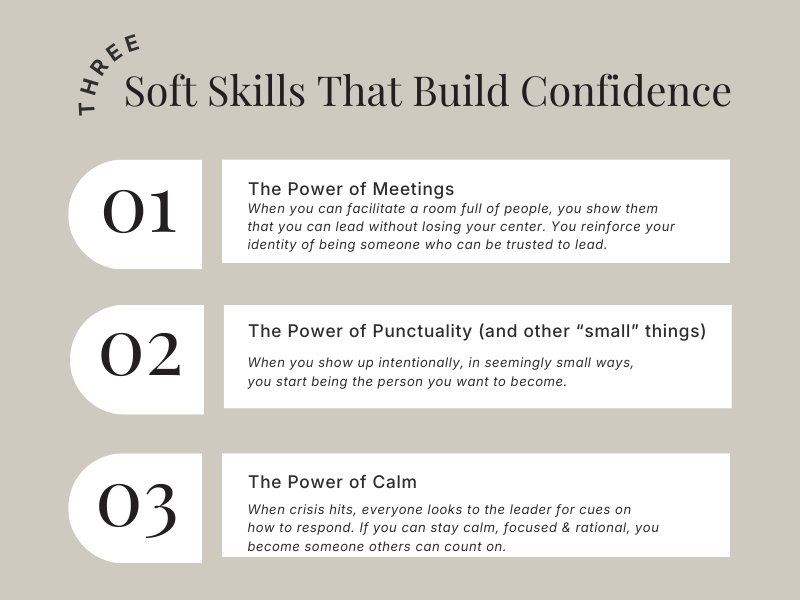
1. The Power of Meetings
A comment I read from someone on the forum: "For me, it was learning how to run an effective meeting. Not just showing up, but having a clear agenda, keeping people on track, and summarizing action items at the end. It made me look organized and competent and drastically reduced wasted time for my whole team."
Here's the truth: How you run a meeting demonstrates how you lead.
A scattered meeting signals scattered leadership. But a meeting with clear intention? That communicates something different: This person knows where we're going and how to get us there.
Running an effective meeting isn't about control, it's about containment. Meetings create a space where people can contribute, where decisions get made and where everyone leaves with a better understanding of what the plan is going forward.
What this looks like:
Before the meeting:
Send an agenda with 3-5 specific topics (not vague themes)
List what decision will need to be made or the desired outcome
Give people time to prepare (24 hours minimum)
During the meeting:
Start by stating the purpose in one sentence
Keep track of time (no one wants their lunchtime taken)
When discussions drift, gently redirect: 'That's valuable and I appreciate the input, send me an email later on and we can talk further or let’s table that for next time.” (acknowledge someone’s contribution but stay on topic )
Summarize & clarify as you go - “So what we just talked about was…” or “What I hear you saying is…”
After the meeting:
After the meeting: Send action items (preferably within 2 hours) with who's responsible and what deadlines need to be met
This isn't about being rigid. It's about being respectful.
This shows people that you respect their time and yours. When I was in corporate, many things annoyed me, but especially random meetings that could have been an email, that ran into lunchtime, or the ones that had no agenda and we all left more confused than when we went in.
Why this builds your confidence:
When you can facilitate a room full of people with competing priorities and keep everyone focused, you demonstrate that you can lead without losing your center.
Every time you run a clear, focused meeting, you're reinforcing an identity: I am someone who creates order. I can be trusted to lead.
2. The Power of Punctuality
A comment I read from someone on the forum: "Being five minutes early to meetings. I did it to calm my nerves to get used to the room. It's what I was brought up with as well. Execs would also be early as a rule, and I got on their radar from small talk. Most everyone else was a few minutes late. My good habit made me stand out and helped me connect with higher-ups."
This seems almost too simple. But that's the point.
It’s the seemingly simple things, the “too easy” things, that we take advantage of.
Solid leadership isn't about grand gestures. It's about consistent small choices that signal: I'm serious. I'm prepared. I'm here.
You have to remember: Small does NOT mean insignificant.
Being early isn't just logistics. It's:
Showing respect for others' time
Giving yourself space to settle your nervous system
Signaling that you're organized and not reactive or frazzled
Creating opportunities for connection before formal business
When you rush into a meeting right on time (or two minutes late), you're already behind. Your heart rate is elevated, you haven't grounded yourself in the space, you missed the informal conversation happening before things officially start.
But when you arrive five minutes early? You choose your seat. You have a spare moment to take a few deep breaths. You have the space to exchange pleasantries with other early arrivers (who are also often decision-makers). You're calm, settled, and present when the meeting begins.
Keep the “simple” in mind:
Other small signals that work similarly:
Writing clear, concise emails (no rambling or tons of scrolling needed)
Responding within reasonable timeframes (you can “push” your team but also manage appropriate expectations)
Following up on what you said you'd do (this is HUGE - people don’t respect people who never follow through with things)
Remembering names and details about people
None of these require you to change your personality - but they do require you to practice. They’re things that you can add and build and layer onto over time. But they’re simple enough that you can pick something and start to implement it immediately.
(I talk about simple but powerful tips just like these in The Weekly Exhale - a note from me every Sunday)
Why this builds your confidence:
When you show up intentionally in small ways, you stop feeling like you're faking it. You start being the person you want to become.
You show up as the leader you once dreamt of being.
Confidence isn't a feeling you wait for - it's a muscle you flex that will get stronger with each practice.
3. The Power of Calm
A comment I read from someone on the forum: "How to react when something is going wrong is so important. When I worked in an office, some people would be overly dramatic about bad news. It put them in a bad mood, and made the person delivering it nervous. I learned to do the opposite. Low volume, calm voice, even respond with 'I appreciate you telling me' once I've been given the information”.
This is advanced leadership, wrapped in simplicity.
When crisis hits, everyone looks to the leader for cues on how to respond.
If you panic, they panic.
If you spiral, they spiral.
But if you stay calm?
You give everyone else permission to think clearly.
It’s not about suppressing emotion or the fact that something just went wrong - it's about nervous system regulation. Your body's stress response will want to hijack you into fight-or-flight. Your job as a leader is to override that pattern and practice a different way.
What this looks like:
In the moment:
Notice your first impulse - How do you typically respond when something goes wrong? When you stub your toe or your computer doesn't turn on immediately or when an employee calls off at the last minute?
Take a slow, deep breath before responding
I always tell my clients - a response is thought out and more logical vs a reaction is emotional and usually impulsive
Slow your voice if you have a tendency to talk quickly and lower your voice volume slightly
Say something grounding: "Okay, let's think through this…” (That works whether you're talking to someone else or walking yourself through an issue!)
Ask clarifying questions: What specifically happened? What are the facts? What do we know for certain? What needs to be figured out immediately?
Writing things down will also signals control and give your brain something to focus on instead of the emotions that may be flooding your system
If you’re someone who does not tolerate stress well, start saying to yourself:
“I'm not rattled. I got this. There's a path forward, I just need to find it.”
Why this builds your confidence:
When you can stay regulated when things around you are uncertain or chaotic, you start to realize you don't need external circumstances to be perfect in order for you to feel in control or empowered.
Your calm is your anchor and you become someone the people around you can count on.
I've watched this transform leaders.
I had a client once who would spiral when projects went off track.
She struggled to grasp things when they weren’t going as planned, because she didn't have the cognitive (and emotional) flexibility to manage. Now she can take a breath, bring her logic back to the forefront and talk through any scenario while remaining collected. Not only does it feel great for her but she watched her team respond differently & more effectively as she learned to better regulate herself.
Maybe you show visible frustration when something is happening. You can learn to respond with "Understood. Let me think about options and get back to you within 24 hours."
Calm literally becomes your superpower.
When you can stay regulated while everything around you feels like they’re in shambles, you realize you don't need external circumstances to be perfect for you to be powerful.
Each time you practice this, you're rewiring your nervous system. You're proving to yourself: I can handle things without falling apart. I have the ability to manage even when things aren't going according to plan.
That's unshakeable confidence.
Your Action Plan: Start This Week
Here's the beautiful truth about soft skills: You don't have to wait for permission, training, or more motivation to start using them.
You can begin today.
My challenge to you:
Choose ONE skill to start practicing…
Option1: The Power of Meetings
Create a clear agenda with 3-5 topics
State the purpose
Summarize action items at the end
Send follow-up within 2 hours
Option 2: The Power of Punctuality
Arrive 5 minutes early this week
Use that time to take three deep breaths and get settled
Notice how different you feel when you're prepared vs. rushed
Option 3: The Power of Calm
Next time something stressful happens (even something small, like stubbing your toe)
Pause for a breath before reacting
Lower your voice slightly
Say “I’m alright, what needs to happen next?” or "Okay, let's walk through this.”
Don't try to do all three, that's your perfectionism talking.
Pick the one that feels most relevant to you and start there…
Keep in mind:
We’re not robots. Here’s what generally happens as you practice new soft skills…
Week 1: You feel awkward. It doesn’t feel quite natural yet. That's okay - you're literally rewiring patterns that have been in place for years. (especially when it comes to punctuality and communication!)
Week 2-3: You’ll start to notice the impact. Someone may comment on your clear meetings. You’ll feel more grounded when you arrive early. Your calm response diffuses tense or stressful situations.
Week 4+: It starts to feel like you. Not something you're performing, but something you are. You’ve been practicing and it starts to feel less foreign.
As you continue:
Your confidence builds from the inside out.
Your nervous system regulates & calms because you're no longer in constant performance mode or frantic-ness.
People respond differently to you because you've shifted your presence and how you show up as a leader and as a human.
These three soft skills are just the beginning…
We’ll chat more in the next blog very soon!
Because the truth about leadership development is this:
Women who excel as leaders aren't the ones with perfect resumes or flawless communication.
They're the ones who realize that leadership isn't about having it all together - it's about being intentional when things seem unclear or uncertain.
It all starts with one small choice. One meeting. One early arrival. One calm response.
You already have what it takes.
You don't need to be more. You need to be a leader with intention.
And those soft skills become very powerful skills…
Ready to build these skills with personalized support?
If you're ready to move from burnt out and running on fumes to having more capacity, and from self-doubt to more self-assured, let's talk about Leadership Coaching.
Because you deserve to lead boldly and live calmly.
More about Leadership Coaching here - contact me any time for a free consultation
Related Resources:
About the Author - Lori Streator is a leadership coach and podcast host for high-achieving women. Based in Bradenton, FL - available online worldwide. Podcast host: Let's Talk About It with Lori Streator